



Former Deputy Chief of Defence Forces General Peter Elwelu has been arrested in Soroti City over alleged subversive activities and claims that he was involved in plans to destabilise the Teso sub-region.
The Uganda People’s Defence Forces (UPDF) announced his arrest on November 2, 2026, bringing renewed attention to a military career that took him from the National Resistance Army in 1987 to one of the country’s most senior military positions.
According to Acting Defence Public Information Director Col Chris Magezi, Elwelu had been on the run over allegations of involvement in activities intended to destabilise Teso.
Magezi said security forces had recovered 15 guns, military fatigues and two pickup trucks allegedly linked to the former army commander. The military also announced that Elwelu would be charged and prosecuted in court.
His arrest comes after Chief of Defence Forces Gen Muhoozi Kainerugaba accused him of involvement in activities against the state and ordered him to surrender. Muhoozi also announced the arrest of more than 20 former soldiers who had served under Elwelu.
However, the military has not publicly explained the specific evidence linking Elwelu personally to the alleged activities or detailed the charges he is expected to face.
Beyond the latest allegations, Elwelu’s name carries a complicated history within Uganda’s security establishment, particularly because of his command during the controversial 2016 Kasese palace assault.
From the NRA to Uganda’s military leadership
General Peter Elwelu joined the National Resistance Army (NRA) in 1987, beginning a military career that would span nearly four decades.
He received military training at Tanzania’s Monduli Military Academy before progressing through the ranks of the Ugandan military.
His early assignments included operations in the Democratic Republic of Congo during the period surrounding the overthrow of former Congolese president Mobutu Sese Seko.
In 1999, he was deployed to northern Uganda to participate in military operations against the Lord’s Resistance Army (LRA), which had waged a prolonged insurgency against the Ugandan government.
Eight years later, Elwelu took command of Uganda’s first military contingent deployed to Somalia under the African Union Mission in Somalia (AMISOM).
The deployment placed him among the officers involved in Uganda’s early military contribution to the African Union’s efforts to stabilise Somalia.
His subsequent assignments included commanding the UPDF Third Division in Moroto and the Second Division in Mbarara.
In June 2013, he was appointed commander of the Second Division, a position that would later place him at the centre of one of Uganda’s most controversial military operations.
The Kasese palace assault that defined his career
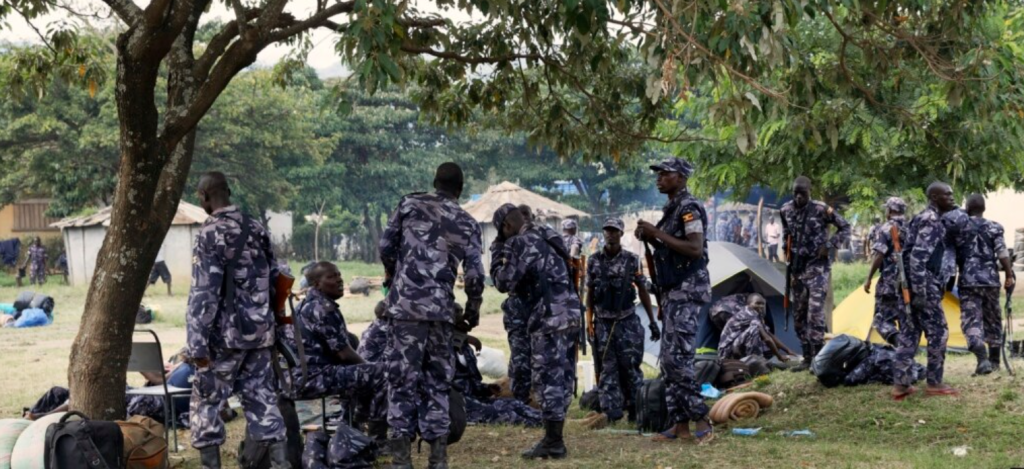
Elwelu’s military career came under intense national and international scrutiny following the November 26 and 27, 2016, assault on the Rwenzururu royal palace in Kasese.
At the time, he held the rank of brigadier general and commanded the UPDF Second Division, which led the military operation against the palace.
The assault resulted in the arrest of Rwenzururu Kingdom cultural leader Omusinga Charles Wesley Mumbere alongside scores of other people.
The government maintained that the operation was necessary to address an armed threat posed by the royal guards. However, the Rwenzururu Kingdom disputed the characterisation of its royal guards as a militia.
The scale of the deaths recorded during the operation attracted condemnation from human rights organisations.
Human Rights Watch documented at least 55 deaths on November 26, including police officers, and more than 100 people killed during the November 27 palace assault.
The organisation also documented the deaths of children and called for an independent investigation into the conduct of security forces.
The International Criminal Court’s Office of the Prosecutor subsequently reported receiving credible information that multiple killings had been committed by Ugandan security forces during the operation.
The ICC office described the operation as having been conducted under Elwelu’s command. Elwelu, however, publicly defended the military’s actions.
Speaking to journalists in May 2021 after taking his oath as a UPDF representative in Parliament, he dismissed questions about possible accountability over the operation.
“The ICC set me free; they said I have no case to answer. So what are you talking about?” he said.
He further defended the actions of the troops under his command, saying: “Those were criminals, I didn’t kill anybody else, they deserved death. Uganda is peaceful because of my actions and Kasese is peaceful.”
His remarks reflected his position on an operation that remained a major subject of human rights criticism.
How Elwelu rose to become Deputy Army Chief
Despite the controversy surrounding Kasese, Elwelu continued to rise through the military hierarchy.
In January 2017, he was appointed Commander of Land Forces, placing him in charge of one of the UPDF’s most important operational formations.
He was promoted to lieutenant general in February 2019, further strengthening his position within the military establishment.
On June 24, 2021, President Yoweri Museveni appointed him Deputy Chief of Defence Forces, making him one of the most senior officers in Uganda’s military.
His tenure included an unusual military alert issued on June 23, 2022, when Elwelu ordered the entire UPDF to Standby Class One, the military’s highest level of combat readiness.
The order, transmitted to military units by radio, included the Kiswahili word “imara” and directed troops to remain on high alert. It also instructed units to halt troop and equipment movements pending further instructions.
When journalists sought an explanation, then-UPDF spokesperson Brig Felix Kulayigye declined to provide details, saying: “That is not for the public.”
Another major development came on May 30, 2024, when the United States Department of State designated Elwelu over his involvement in gross violations of human rights, specifically extrajudicial killings committed by UPDF members while he commanded forces. The designation made him ineligible to enter the United States.
Later in 2024, he was replaced as Deputy Chief of Defence Forces by Lt Gen Sam Okiding and subsequently assigned presidential advisory responsibilities relating to Teso and Karamoja.
Retirement, social media and Muhoozi’s threats
Elwelu retired from active military service in 2025 after a career spanning almost four decades. His departure from the military did not completely remove him from public attention.
He became increasingly visible on social media through videos showing him exercising, preaching and delivering religious messages. His wife, Patricia Apolot, told New Vision that he had welcomed retirement and wanted to enjoy a quieter life.
However, Apolot also revealed that her husband had expressed concerns about his personal security following retirement and had asked President Museveni to retain his security detail.
His retirement was also accompanied by public exchanges with Muhoozi, who had already threatened to arrest him in December 2024.
In posts on X, Muhoozi referred to the former general using insulting language and warned that he would eventually capture him.
“There is one fool that I will arrest soon. He is hiding behind my father, but I will capture him. He comes from Teso,” Muhoozi wrote.
The December 2024 remarks attracted attention because Elwelu had previously occupied one of the most influential positions in the military.
Peter Elwelu’s arrest: What happens next?
The latest developments have brought Elwelu’s military career to an unexpected point, with the former Deputy Chief of Defence Forces now facing allegations from the very institution he once served.
In late October 2026, Muhoozi accused him of involvement in activities intended to destabilise Teso and ordered him to surrender.
The military subsequently announced the recovery of weapons and ammunition from one of his homes, alongside the arrest of former soldiers who had served under him. On November 2, the UPDF confirmed that Elwelu had been arrested in Soroti City.
The army said he would be charged and prosecuted in court, although the specific offences and evidence supporting the allegations had not been publicly detailed at the time of the announcement.
Elwelu’s arrest therefore opens another chapter in the career of a former military commander whose rise through Uganda’s security establishment was accompanied by significant controversy.
From his early years in the NRA and military deployments abroad to the Kasese palace assault, his appointment as Deputy Chief of Defence Forces, international human rights sanctions and eventual retirement, his career has attracted both institutional recognition and public scrutiny.
His latest arrest now places the former general at the centre of a new legal and political controversy, with the allegations against him yet to be tested in court.

